
Where Kootenai Crime News Appears
Crime news in Kootenai County comes from two places. One is official agency releases. The other is local journalism. The Coeur d'Alene Press keeps the deepest public-safety archive of any local outlet. Kootenai County News runs a Public Safety section of its own. For regional depth, look to KHQ and the Spokesman-Review, with Hagadone News Network and the Kootenai Journal adding selected stories.
One caution is worth learning early. A news timeline is not a jail timeline. A story might run days after the sheriff's release, get updated after a hearing, or stay online long after the person is free. Photos vary too. The image could be a booking photo, a scene shot, or a newsroom picture. Call it a mugshot only when the article or agency actually says so.
Kootenai Outlets and Photos
The table keeps two things separate. One is who published the item. The other is what the image actually shows. Official channels sit at the top for a reason. Secondary pages can help you track a dated story or an older roster. But they go stale, copy each other, and sometimes get details flat wrong. Treat none of them as the final word on who is in custody right now.
| Outlet or source | Coverage | Photos? | Where |
|---|---|---|---|
| KCSO Media Releases | Selective sheriff investigations, arrests, warnings, and public information | Some releases or older reports may include a source-specific image | Official releases |
| Coeur d’Alene Press | County blotter, courts, public safety, and city or rural events | Historical KCSO story shows agency-released mugshots; routine feed not verified | News section |
| Kootenai County News | Public Safety stories across Post Falls, Coeur d’Alene, Rathdrum, and more | Story photos are not a routine booking gallery | Public Safety |
| KHQ / NonStop Local Idaho | Regional public-safety reports, including Kootenai incidents | Scene, file, agency, or story-specific image | Idaho news |
| Spokesman-Review | Regional Kootenai arrest and court coverage | Newsroom image is not presumed to be a booking photo | Kootenai arrest story |
| Hagadone News Network and Kootenai Journal | Selected local or community crime reports | Story-specific; routine roster not verified | Hagadone example / Kootenai Journal crime tag |
| RecentlyBooked | Private countywide recent-arrest discovery page | Private claims and images require official comparison | Kootenai page |
| Mugshots.com | Historical Kootenai name and date index, mainly 2012 to 2017 in the audit | Historical private page, not current KCSO proof | County index |
| JailRosters | Private dated PDF archive lead | Underlying file availability and identity need verification | Kootenai archive |
That official-first order exists for a reason. A third-party site might show a result hours before or after the sheriff's office does. A newspaper can report an arrest without ever touching the booking record. So before you repeat a name, a charge, or a custody status, check the source underneath the claim. This Coeur d'Alene Press story from the archive is the source for the local-news capture shown below.
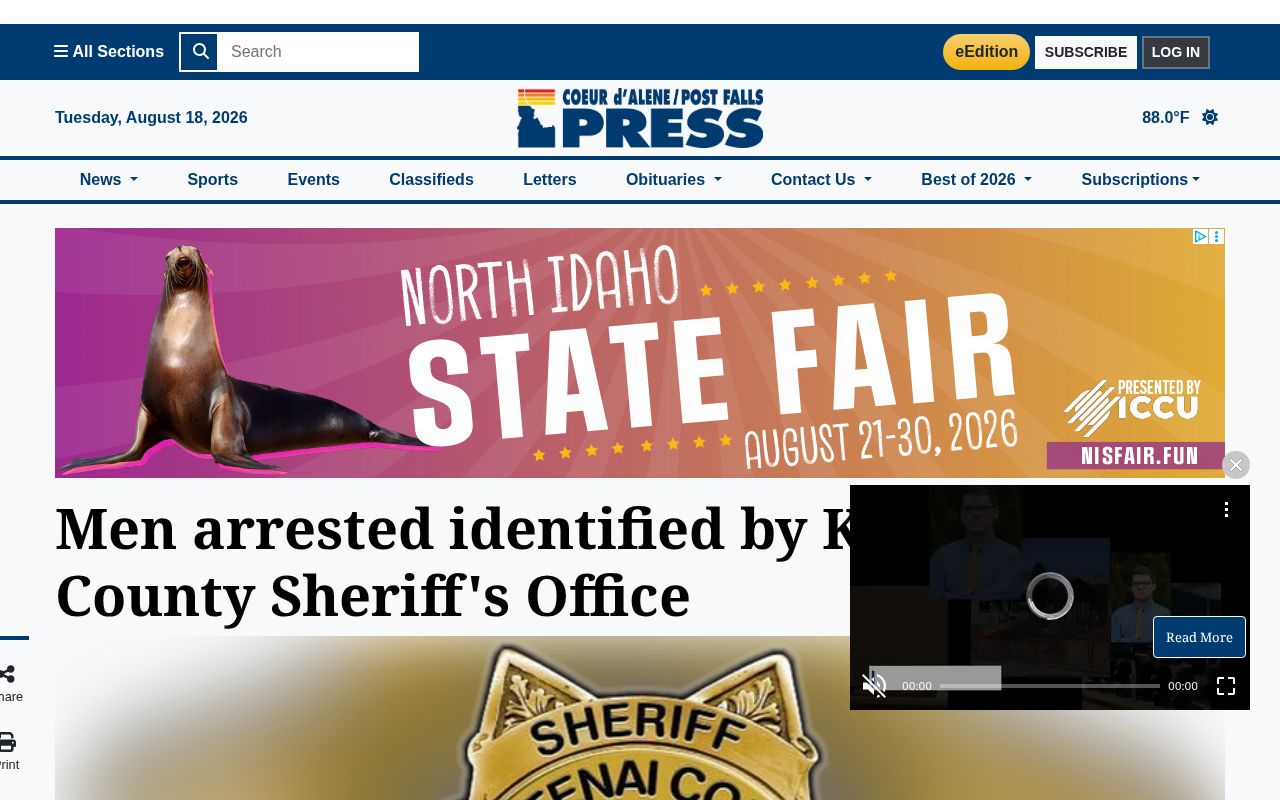
The article demonstrates episodic agency-released imagery, not a daily public mugshot stream.
How Kootenai Booking Photos Reach News
Why do booking photos exist at all? Idaho Code §20-601 requires a photograph during county-jail booking. That mandate explains the image, but it does not force the KCSO roster or the Daily Press Log to publish one. Neither showed a routine photo field in its PDF. A newsroom gets an image some other way: a KCSO media release, a police release, a public-records response, or a decision made for one specific story.
The label matters, and the source decides it. When an article says KCSO released a booking photo, that story earns the phrase "agency-released booking photo." A scene shot, a body-camera still, or a file image deserves its real name. Also keep two gaps in mind. A story without a photo does not prove no booking photo exists. And a photo on some private page proves nothing about KCSO authenticity.
Editors choose which images run. A story photo can be selective, years old, or quietly corrected later. It is never a substitute for the current custody list or the court file.
From Kootenai News to the Record
Think of a news story and the official record as two different documents. The story gives you the event: what happened, when, which agency, and the narrative around it. The record gives you the hard fields. Those include custody status, booking responses, and court entries. Follow the chain from one to the other without assuming they match at the same moment.
- Save the article’s headline, publication date, named agency, location, and case identifiers.
- Open the KCSO current inmate list and Daily Press Log to ask whether the person is represented in current custody or in the displayed recent window.
- Compare the arresting agency. Request the city incident packet from CDA PD or PFPD when that agency made the arrest, and request the county booking record or photograph from KCSO.
- Use Idaho iCourt or the District Court records path for the case and disposition.
- Describe only the status supported by the source. A story is not a conviction, a release is not a dismissal, and a missing roster row does not explain why it disappeared.
Local coverage stretches across Coeur d'Alene, Post Falls, Hayden, Athol, Rathdrum, and the unincorporated county. Each city page explains its own local handoff. The home page carries the countywide roster plus the records-request path.
Kootenai Blotters Are Episodic
The Coeur d'Alene Press runs a KCSO blotter that rounds up notable calls, totals, and selected arrest and warrant narratives. It is a dated media archive. It is not a running jail feed. Kootenai County News and KHQ publish public-safety stories more often, though each outlet skips releases, revises stories after publication, or zeroes in on a single incident.
The practical answer is a two-source habit. News gives you context and agency statements. KCSO PDFs or a records request give you custody and booking fields. One more thing to expect: a report may mention a juvenile, a federal hold, or a warrant without ever laying out the full record or the final court result. The dated KCSO blotter example shows how a single story can cover Hayden, Athol, and unincorporated areas at once.

The image here is a capture of a local-news source. It does not turn a blotter into a current custody list.
Secondary Kootenai Mugshot Pages
Secondary sites fill a niche. Each has quirks worth knowing. RecentlyBooked claims multiple refreshes per day and calls its Kootenai page a public-record source. Mugshots.com skews historical for this county. JailRosters links to dated Kootenai PDFs, though at least one link returned a cache miss. JailExchange and KootenaiCountyJails work better as discovery pages or facility explainers than as controlling custody sources.
Use private pages for one purpose: finding a date or article worth verifying. Then compare the name, arresting agency, date, offense, and case number against KCSO and iCourt. A sponsored search block or a copied photo is never official. If a private page is wrong or stale, use the publisher's documented free correction route if one exists. Keep your official paperwork. The JailRosters Kootenai archive page is the source for the secondary archive capture below.
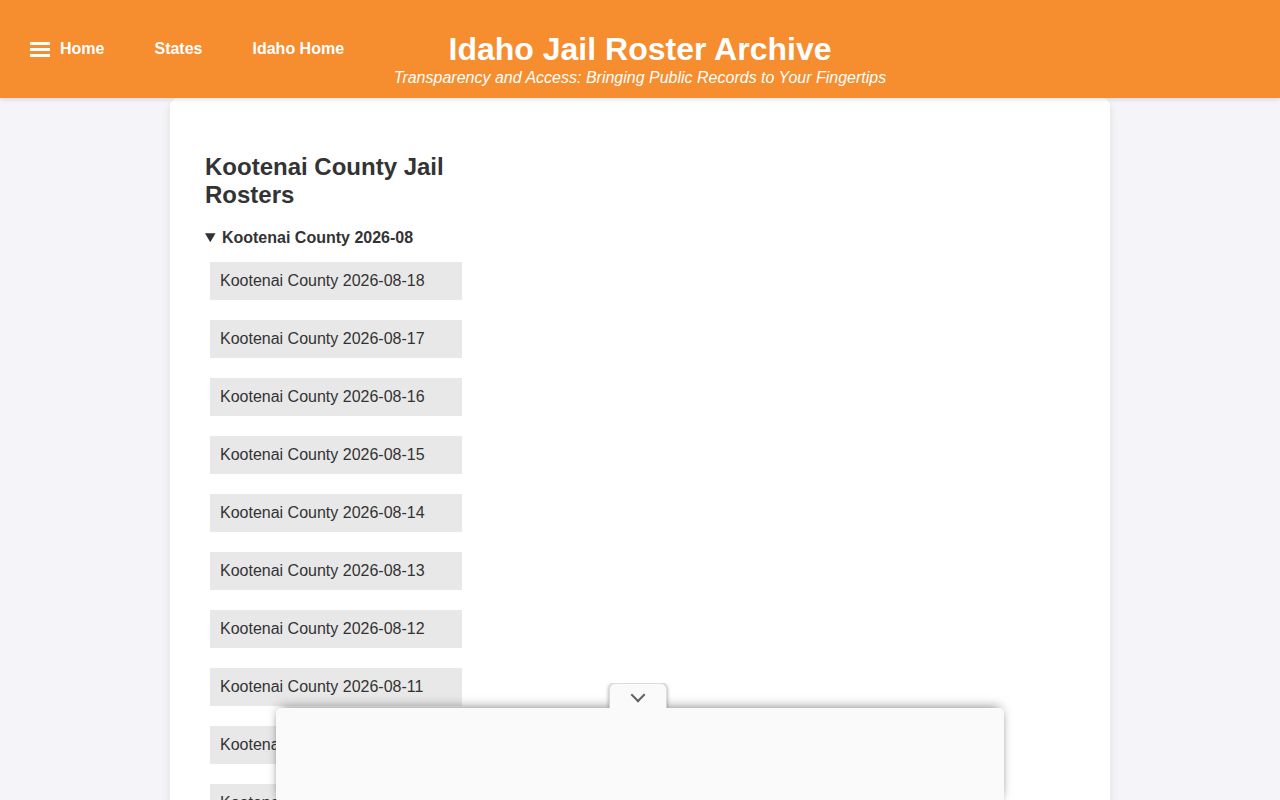
An archive lead can point you toward an older document. Only KCSO can confirm what its records actually contain.
Kootenai Pages Not Located
Some well-known private sites have no Kootenai County presence at all. The BustedNewspaper Idaho landing page carries no county-local section. The Arrests.org Idaho directory leaves Kootenai out of its county navigation. And Mugshots.zone shows no Idaho section at all. Treat those absences as unstable. A redesign or a new county page could change the picture without warning. Don't guess at a county URL on the hope that one appears.
Other names surface in searches, but they carry little weight. KootenaiCountyJails is an SEO discovery page. JailExchange is a secondary facility explainer. Neither one outranks the official KCSO PDFs. A national directory's state landing page is also weak proof that a county actually participates; a URL in a search result is not a verified Kootenai feed.
The fallback stays the same regardless of what private publishers do. KCSO answers the custody and booking question. The arresting city department holds the incident packet. The court docket settles the outcome. Any private listing that shows up later should be tested for freshness, identity, and a working correction route before it earns any trust. That order keeps a news search from turning into an unsupported identity claim.
Kootenai News Is Not Disposition
Headline language moves fast. Courts move slowly. Words like "arrested," "suspect," "wanted," or "booked" appear because a case is young, while the docket may later show dismissal, a plea, a reduction, sealing, or judgment. So read the docket. Copying the strongest word from a headline is the quickest way to get a Kootenai story wrong.
Coverage can also trail a federal or immigration hold rather than a county case. A Coeur d'Alene Press story about an Athol arrest, for instance, reports an agency event, not a final immigration result. Keep custody status and what a court eventually recorded in separate sentences. They answer different questions about the same person.
Follow the dated court disposition before describing what a Kootenai County arrest became.